Consumer Equilibrium
In this post, you’ll learn about the consumption pattern of a consumers and the choices they make.Firstly one should know that there is a difference between consumer and customer.Consumer is one who buy goods and avail services for the satisfaction of his/her want but customer can buy or avail the service for himself or for the other person means he may or may not be the actual person to consume the commodity.Now the question arise what is Consumer Equilibrium " It refers to a situation in which consumer get maximum satisfaction by consuming a commodity which could be purchased by his/her limited income".A rational consumer will purchase a commodity up to the point where price of the commodity is equal to the marginal utility obtained from the commodity.
There are two main approach to study the consumer equilibrium and consumer behaviour.
1) Cardinal utility approach also known as marginal utility analysis.
2) Ordinal utility approach also known as indifference curve analysis.
In this article we will discuss how the consumer maximise satisfaction from consumption of goods and service
lets begin with cardinal utility approach.
The Cardinal Utility approach was propounded by neo-classical economists.People consume different goods and services in order to maximise the satisfaction level. Economist believed that utility is measurable and the consumer can express his satisfaction in cardinal or quantitative numbers, such as 1,2,3, and so on.To measure utility hypothetical unit called as “Utils” are used, meaning the units of utility.So utils are imaginary and psychological units which are used to measure satisfaction obtained from consumption of a certain quantity of a commodity.Utility can be measured in terms of money or price which the consumer is willing to pay.There is an advantage of using the monetary values instead of utils as comparison become easier.
Important concept under utility are total utility, marginal utility, law of diminishing marginal utility.
Total utility
Total Utility refers to the sum of utility that an individual derives from the consumption of all the units of a given commodity at a point or over a period of time.
Total satisfaction derived from the consumption of various units of goods and services is called total utility.
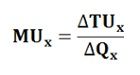 Where,
TUx = is the total utility
ΔQx = is change in quantity as a result of consumption of an additional unit.
and ‘n’ =number of units are consumed, then the marginal utility can be measured as:

In the above figure, the marginal utility of different glasses of water is measured on the y-axis and the units (glasses of water) on X-axis. With the help of the schedule, the points A, B, C, D, E, F and G are derived by the different combinations of units of the commodity (glasses of water) and the marginal utility gained by different units of commodity. By joining these points, we get the marginal utility curve. The marginal utility curve has the downward negative slope. It intersects the X-axis at the point of 6th unit of the commodity. At this point "F" the marginal utility becomes zero. When the MU curve goes beyond this point, the MU becomes negative. So there is an inverse functional relationship between the units of a commodity and the marginal utility of that commodity.
There are two main approach to study the consumer equilibrium and consumer behaviour.
1) Cardinal utility approach also known as marginal utility analysis.
2) Ordinal utility approach also known as indifference curve analysis.
In this article we will discuss how the consumer maximise satisfaction from consumption of goods and service
lets begin with cardinal utility approach.
The Cardinal Utility approach was propounded by neo-classical economists.People consume different goods and services in order to maximise the satisfaction level. Economist believed that utility is measurable and the consumer can express his satisfaction in cardinal or quantitative numbers, such as 1,2,3, and so on.To measure utility hypothetical unit called as “Utils” are used, meaning the units of utility.So utils are imaginary and psychological units which are used to measure satisfaction obtained from consumption of a certain quantity of a commodity.Utility can be measured in terms of money or price which the consumer is willing to pay.There is an advantage of using the monetary values instead of utils as comparison become easier.
Important concept under utility are total utility, marginal utility, law of diminishing marginal utility.
Total utility
Total Utility refers to the sum of utility that an individual derives from the consumption of all the units of a given commodity at a point or over a period of time.
Total satisfaction derived from the consumption of various units of goods and services is called total utility.
Suppose a consumer consumes four ice cream at a point of time and derives different utilities from the successive consumption of ice creams as u1, u2, u3, u4, then the total utility from the consumption of all possible units of ice cream can be measured as follows:
TU = u1+u2+u3+u4
TU = u1+u2+u3+u4
where,
TU = total utility from consumption of all units
u1,u2,u3,u4 = utility from 1st,2nd,3rd and 4th unit.
TU = total utility from consumption of all units
u1,u2,u3,u4 = utility from 1st,2nd,3rd and 4th unit.
Within the given limited resources (money), the consumer tries to consume different combinations of goods and services in order to maximise his total satisfaction.
Marginal UtilityMarginal Utility refers to the additional benefit (utility) a consumer derives from the consumption of one additional unit of good or service.In other words, marginal utility is the addition to the total utility resulting from the consumption of one additional unit of the commodity. Thus, it can be measured as the change in the total utility obtained from the consumption of an additional unit, say X, Symbolically it can be represented as:
Where, TUx = is the total utility
ΔQx = is change in quantity as a result of consumption of an additional unit.
and ‘n’ =number of units are consumed, then the marginal utility can be measured as:
MUn = TUn – TUn-1
The marginal utility is positive when the consumption of an additional unit of good or service results in the increase in the total utility. On the other hand, it is negative when the additional unit consumed results in the decrease in the total utility. The concept of marginal utility is based on the notion that the satisfaction derived from the consumption of an additional unit of the commodity keeps on decreasing.
Such as, if the consumer keeps on consuming additional unit of the product, then the satisfaction derived from each successive unit goes on decreasing. For example, if you are very thirsty then the utility derived from the first glass of water will be maximum and will go on diminishing with each additional glass. This is called as the Law of Diminishing Marginal Utility.
Law of Diminishing Marginal UtilityLaw of Diminishing Marginal Utility states that as we consume more and more units of a commodity , the utility derived from each successive unit goes on decreasing.This law was first given by a German economist H.H. Gossen.
Assumptions of Law of Diminishing Marginal Utility
The law is said to hold true under certain conditions, and these conditions are referred to as the assumptions of the law .These are:
- Consumption of reasonable quantity : It is assumed that the unit of the consumer good is a standard one, i.e. the rational quantity of the commodity is consumed. Such as, a cup of tea, a pair of shoes, bottle of cold drink, glass of water, etc.
- Cardinal measurement of utility : It is assumed that the utility is measurable, and the satisfaction of the consumers can be expressed in the quantitative terms.
- Taste and Preference : The consumer’s tastes and preferences remain same during the period of the consumption.
- Continuous Consumption : There must be continuity in the consumption.For example, if one ice cream is consumed in the morning and another in the evening, then the second ice cream may provide equal or higher satisfaction as compared to first one.
- No change in quality : It is assumed that the quality of the commodity remains uniform during the period of consumption.
- Independent utilities : All the commodities consumed by the consumer are said to be independent of each other, such as the marginal utility of one commodity has no relation with the marginal utility of another commodity.
- Fixed income and Prices : It is assumed that the income of the consumer and the price of goods and services remains unchanged during the period of consumption.
- MU of money is constant : The marginal utility of money remains constant for the consumer.
- Normal situation : The mental condition of the consumer should remain normal during the consumption period. For example, if a person drinks any alcoholic drink, then he will derive more pleasure with each additional glass of drink, this is because of a change in his mental status due to intoxication.
The conditions of diminishing marginal utility hold universally. But, however, in certain conditions such as accumulation of money, hobbies of collecting stamps, old coins, songs, etc. the marginal utility might initially increase, but eventually it decreases.
Explanation With Schedule and Diagram:
We assume that a man is very thirsty. He takes the glasses of water successively. The marginal utility of the successive glasses of water decreases, ultimately, he reaches the point of satiety. After this point the marginal utility becomes negative, if he is forced further to take a glass of water. The behavior of the consumer is indicated in the following schedule:
| Units of commodity | Marginal utility | Total utility |
| 1st glass | 10 | 10 |
| 2nd glass | 8 | 18 |
| 3rd glass | 6 | 24 |
| 4th glass | 4 | 28 |
| 5th glass | 2 | 30 |
| 6th glass | 0 | 30 |
| 7th glass | -2 | 28 |
On taking the 1st glass of water, the consumer gets 10 units of utility, because he is very thirsty. When he takes 2nd glass of water, his marginal utility goes down to 8 units because his thirst has been partly satisfied. This process continues until the marginal utility drops down to zero which is the saturation point. By taking the seventh glass of water, the marginal utility becomes negative because the thirst of the consumer has already been fully satisfied.
The law of diminishing marginal utility can be explained by the following diagram drawn with the help of above schedule:

In the above figure, the marginal utility of different glasses of water is measured on the y-axis and the units (glasses of water) on X-axis. With the help of the schedule, the points A, B, C, D, E, F and G are derived by the different combinations of units of the commodity (glasses of water) and the marginal utility gained by different units of commodity. By joining these points, we get the marginal utility curve. The marginal utility curve has the downward negative slope. It intersects the X-axis at the point of 6th unit of the commodity. At this point "F" the marginal utility becomes zero. When the MU curve goes beyond this point, the MU becomes negative. So there is an inverse functional relationship between the units of a commodity and the marginal utility of that commodity.
Importance of the Law of Diminishing Marginal Utility:
1)By purchasing more of a
commodity the marginal utility decreases. Due to this behaviour, the consumer
cuts his expenditures to that commodity
2)In the field of public
finance, this law has a practical application, imposing a heavier burden on the
rich people.
3)This law is the base of some other economic
laws such as law of demand, elasticity of demand, consumer surplus and the
law of substitution etc.
4)The value of commodity falls by increasing the
supply of a commodity. It forms a basis of the theory of value. In this
way prices are determined.

No comments:
Post a Comment